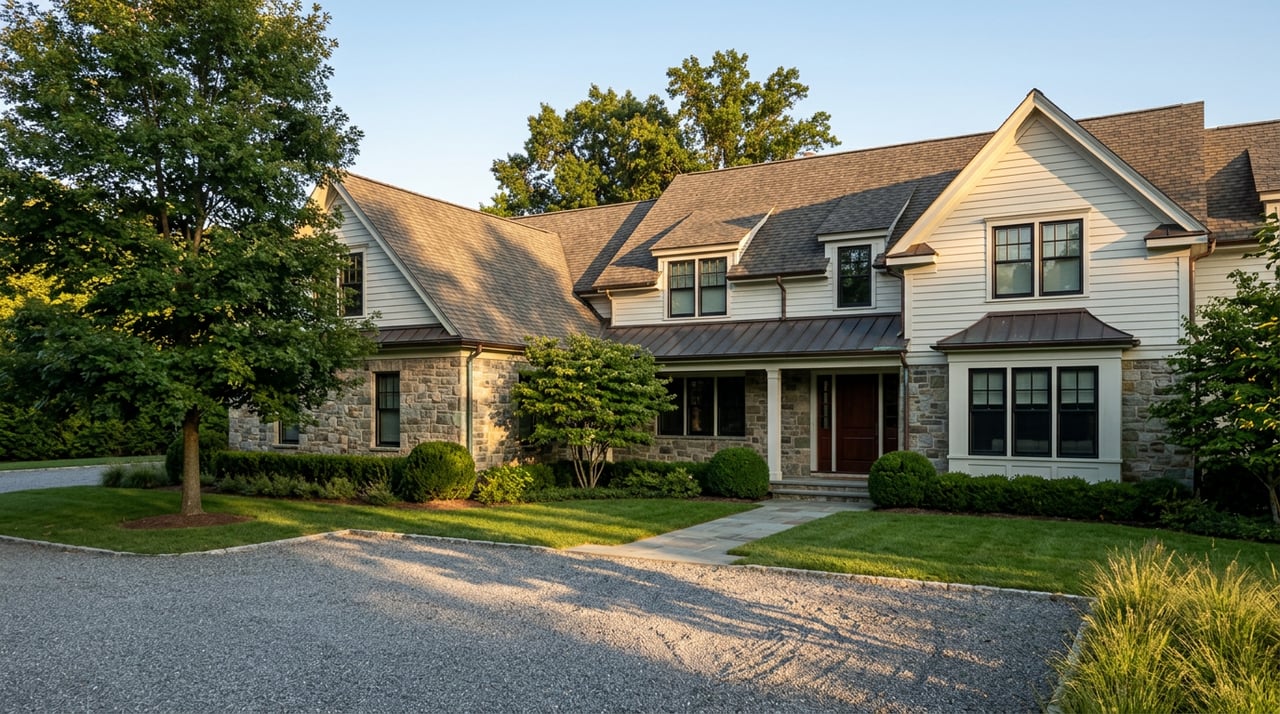
The Acreage Number on a Colts Neck Listing Isn't the Number That Sets the Price
September 17, 2026
September 17, 2026
A homeowner on Warrenton Lane recently asked the Colts Neck Zoning Board of Adjustment for permission to build a few steps down to a basement. Not a pool. Not an addition. Steps. The application went to a variance hearing because the property already sits at 22.5 percent lot coverage against a 20 percent cap, and the new steps would push it to 22.8 percent. A few doors over on Manor Road, a different owner needed a variance just to build a single-family home in the A-3 zone, because the design called for 9.77 percent building coverage where the district allows 6.6 percent.
Neither of these properties is a modest starter lot. They're in a township where the median home carries a seven-figure price tag and buyers routinely shop by the acre. And both cases make the same point: in Colts Neck, the number on the listing sheet that says how many acres you're buying is not the number that tells you what you can actually do with the land. That second number lives in the zoning code, not the deed, and the gap between the two is where a lot of the real value, and a lot of the real friction, actually sits.
Colts Neck organizes most of its residential land into a run of agricultural-residential districts, A-1 through A-4, plus a separate AG district, with A-3 specifically carved out for older neighborhoods that already have smaller, established lot sizes. The stated purpose of the A-1 and A-2 districts is to encourage the orderly development of open lands and the continuation of farms, and to protect views, wooded areas, mature trees and environmentally sensitive land as that development happens. The township allows cluster development in A-1 specifically to keep open space, floodplains, and wooded tracts intact while still letting farming continue on the same tract. That framework traces back to a base zoning map dated February 1988, amended repeatedly since, and it still does the same job today: it decides how many houses a piece of open land can eventually hold, long before any single buyer shows up.
What that means on the ground is that two six-acre lots a half mile apart can carry completely different development math depending on which sub-district they sit in, what wetlands or buffer areas eat into the parcel, and what coverage ratio already exists on the property. A buyer comparing listings by acreage alone is comparing deeded land, not usable land. The zoning board docket is full of owners who found that gap the hard way, usually while trying to add something far smaller than a new wing.
Acreage in Colts Neck is often a proxy for one specific ambition: keeping horses. The township's code allows horses and ponies in every zoning district, which sounds like an open door until you read the next clause. On any lot of five acres or less, in any district, the code caps the total at five horses or ponies, in any combination, for any purpose. Five acres sounds generous until a buyer starts doing the math on a working barn, a ring, a run-in shed, and a pasture rotation that keeps the ground from turning to mud by February.
The accessory-use rules add another layer specific to Colts Neck's farm heritage. The code permits keeping farm animals as an accessory use only on a lot that is the subject of a farmland assessment, meaning the animal-keeping rights on a given parcel are tied to a New Jersey tax program, not simply to the zoning district the property sits in. A buyer who assumes any A-1 lot automatically comes with full farm rights is assuming past what the code actually says. The farmland assessment status is something to confirm on the specific parcel, not to infer from the zoning map.
The code closes one more door outright, regardless of acreage: private helistops are prohibited as a principal, accessory, or conditional use in every zoning district in the township. It's a small provision, but it's a useful signal. Colts Neck's zoning wasn't written to leave estate buyers guessing about what unlimited money and unlimited acreage might attempt. Certain uses are settled, full stop, no matter how many acres come with the deed.
The stormwater and site-design sections of the code add a further deduction most buyers never think to ask about. Colts Neck requires stormwater management measures, including green infrastructure best-management practices, on qualifying development, and those requirements shape where a house, driveway, barn, or pool can actually sit on the lot once wetlands, buffers, and drainage easements are factored in. A ten-acre parcel with meaningful wetlands or a drainage easement running through it isn't a ten-acre buildable envelope. It's whatever remains once those constraints are subtracted, and that number doesn't appear anywhere on a listing sheet.
This is the practical reason the Soliman and Delquaglio variance applications matter beyond their specific addresses. Both properties ran into their limits at ordinary scale, a basement step and a single-family home, not at the scale of a compound with a barn and a ring. If routine additions require a variance hearing, an ambitious build plan on raw acreage deserves the same scrutiny before an offer goes in, not after closing.
Drive the intersection of Route 34 and County Road 537 on a Saturday and you'll pass Delicious Orchards on one side and Eastmont Orchards a short distance away, with Colts Neck Stillhouse anchoring the corner. That cluster isn't incidental to the real estate story. Land that borders preserved farmland or an established orchard operation buys a buyer something the deed doesn't list: a durable, permanent view that isn't going to become someone else's subdivision in five years. Land that borders a parcel still zoned for further residential development is buying something different, an option on future change rather than a guarantee of permanence. The acreage figure treats both situations identically. The zoning map and the neighboring parcel's status do not.
The same logic that applies to acreage applies to price. Ask three different sources what Colts Neck homes are actually selling for and you'll get three different answers depending on what each one is measuring. Looking at the 07722 zip code specifically, the three months ending in May 2026 put the median sale price at roughly $1.3 million, with homes typically selling in about two weeks in a market where buyer competition remains tight. Widen the lens to active list prices in August 2026 and the median climbs closer to $1.7 to $1.8 million, a figure that reflects what sellers are asking rather than what buyers are paying. An automated home-value estimate for the township lands lower still, in the $1 million range, because that figure is a model averaged across the full range of housing stock rather than a snapshot of recent closings.
None of those numbers is wrong. They're measuring different things, over different windows, with different math, the same way a listing's acreage figure and its buildable envelope are both accurate and both describing something different. The headline number is a starting point for a conversation, not the answer to it.
A few questions are worth answering before acreage becomes the deciding factor between two properties:
Does five acres guarantee I can keep horses in Colts Neck? It guarantees you're past the strictest tier of the cap. On any lot of five acres or less, the code limits horses and ponies to five total, in any combination. Above five acres, the math changes, but setback and accessory-structure rules still apply, so it's worth confirming against the specific parcel rather than assuming.
Can I build a helicopter pad on a large estate lot? No. Private helistops are barred as a principal, accessory, or conditional use in every zoning district in the township, regardless of lot size.
What's the real median price in Colts Neck right now? It depends what's being measured. Closed sales in the 07722 zip code over the three months ending in May 2026 ran near $1.3 million. Active list prices in August 2026 sat closer to $1.7 to $1.8 million. Treat any single median as a starting reference, not the final word, and ask what window and what data set it's built from.
Acreage tells you what's on the deed. It doesn't tell you what the township will let you build, what the land next door might become, or what a house is actually trading for this month versus what it's asking. If you're comparing Colts Neck properties and want the buildable-envelope math run before you write an offer, not after, The Haven Group is glad to walk through it with you.

At Haven Group, real estate is about more than transactions—it’s about helping people feel confident and supported through every step of the journey. Backed by a collaborative team approach, we provide clear communication, honest guidance, and seamless service for buyers, sellers, and investors from start to finish.
Get In Touch To Learn More
The Haven Group
513 Cookman Ave Asbury Park, NJ 07712